
California Projected Versus Actual Release
California uses several dates that answer different questions. For a determinate prison term, the official regulatory phrase is Earliest Possible Release Date, or EPRD. Title 15 section 3371.1 defines it as the earliest date possible under the calculation at that time, assuming the maximum conduct credit and no forfeiture. A Maximum Release Date reflects the full court-imposed term after the credits specified by the rule. Neither label should be treated as the time someone will walk out.
A parole-eligible date is different. It identifies when a person may receive parole review or a hearing under the applicable path. CDCR and the Board of Parole Hearings identify minimum, youth, elderly, and nonviolent parole-eligible dates, among others. Eligibility opens a decision process. It is not a grant, and a grant is not itself a completed release. The actual exit can also depend on reviews, holds, and release processing after a decision.
A pretrial detainee often has no sentence-based projected date at all. Bail, own-recognizance orders, case dismissal, plea, sentencing, remand, and holds can change the next step. The county jail and filing superior court are the sound sources for that case, not a state-prison EPRD formula.
California EPRD Is Fluid
California's EPRD assumes the maximum conduct credit available under the calculation when it is made. Credits can later be earned, denied, lost, or restored. Each change can move the date. That feature is not an error in the record. It is built into the definition. The calculation belongs to CDCR case-records staff, who apply the sentence, offense rules, credit eligibility, and later events to the individual file.
The CDCR and BPH parole eligibility explanation separates EPRD from parole-eligible milestones.
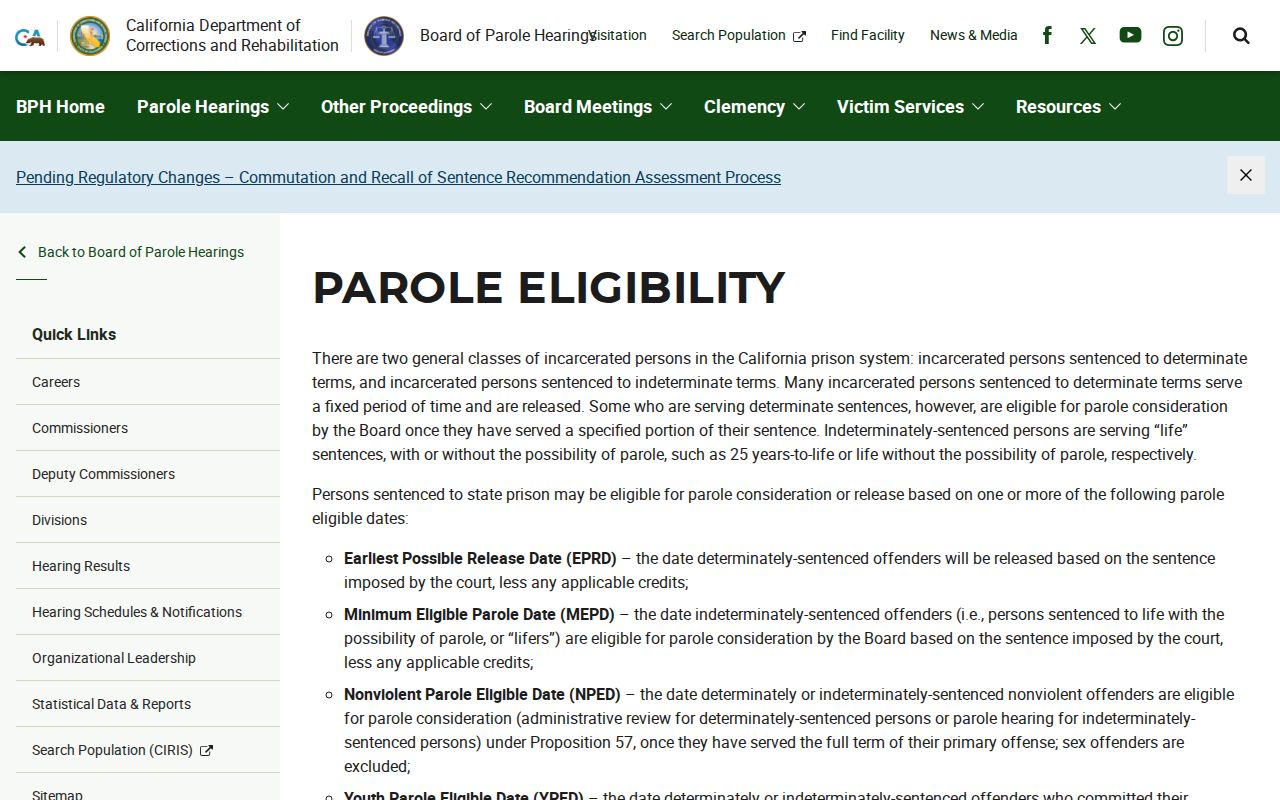
The distinction matters when reading CIRIS. CDCR's documented public result includes a parole-eligible month and year, not a general completed release date. It is inaccurate to relabel that field as EPRD or to infer an exact day. A person may have an internal EPRD calculation while the public locator shows a different parole milestone.
Penal Code section 2932(e) requires notice to the incarcerated person of the anticipated time-credit release date and later changes caused by lost, denied, restored, or worktime credits. That direct notice is often more specific than the month-and-year field visible to the public. A family member seeking an exact date should ask the incarcerated person for the current notice or use the proper CDCR contact route, while recognizing that access and disclosure rules still apply.
Note: EPRD and parole eligibility can move on separate tracks, so record the exact label, source, and date of each value.
Find California Prison Release Dates
Begin with the CDCR number if the person is serving a California state-prison term. It is a stronger identifier than a common name. CIRIS accepts a CDCR number or name and allows age-range narrowing. A documented result may show the person's name, age, CDCR number, current institution, admission date, commitment county, and parole-eligible month and year. The result confirms current CDCR custody. It does not give a documented historical “Released” or “Discharged” record.
- Open CIRIS and accept the official disclaimer.
- Search by CDCR number when it is known. Otherwise use the full name and available age range.
- Compare age, commitment county, institution, and CDCR number to rule out a namesake.
- Write down the public field exactly as labeled, including whether it is a parole-eligible month and year.
- For an EPRD or exact time-credit calculation, use CDCR's Identification Unit or the person's case-records channel.
- Recheck before the expected event because credits, holds, or legal action may have changed the calculation.
The California CIRIS search is the official current-custody locator.
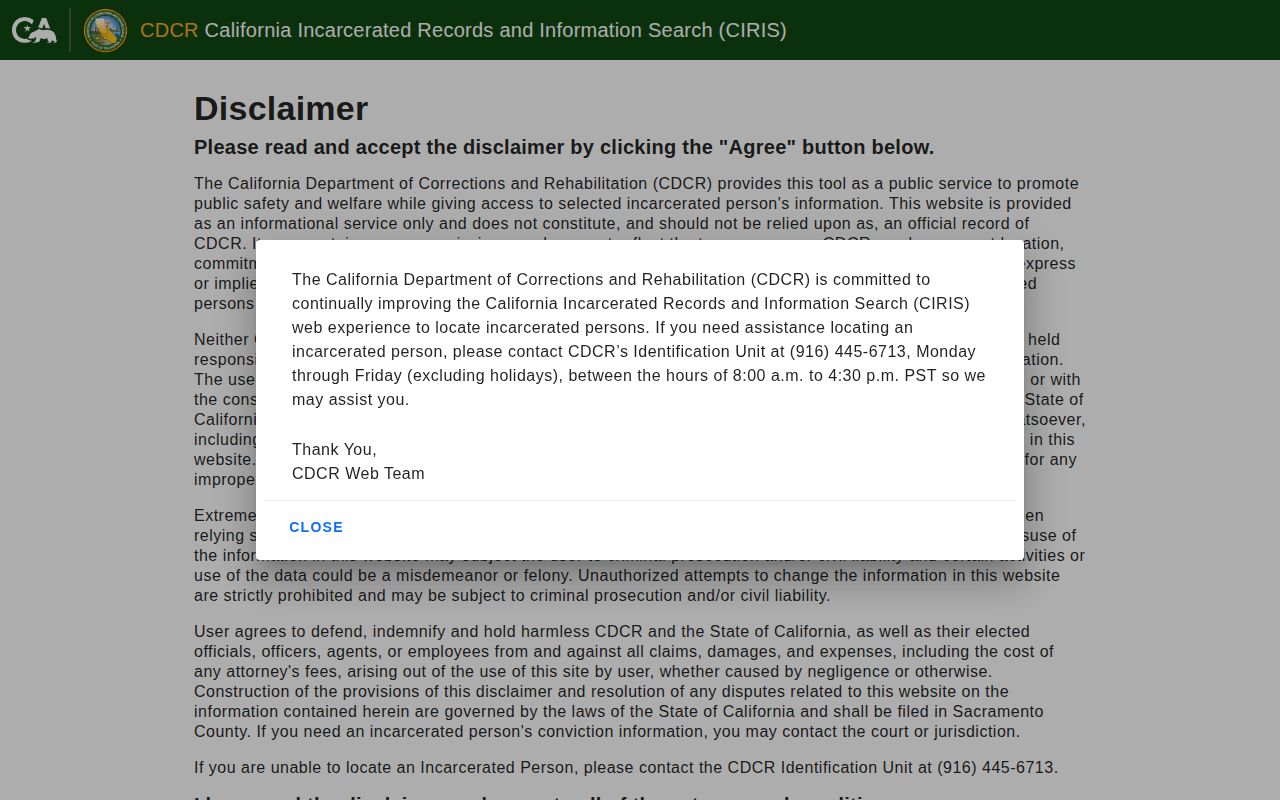
If CIRIS returns no match, do not call the person released. CDCR does not state that CIRIS preserves former-prisoner results. Absence can also mean a transfer, omission, spelling problem, or identity mismatch. The department's Identification Unit handles identification and current-location questions at 916-445-6713, Monday through Friday excluding holidays, from 8:00 a.m. to 4:30 p.m. Pacific.
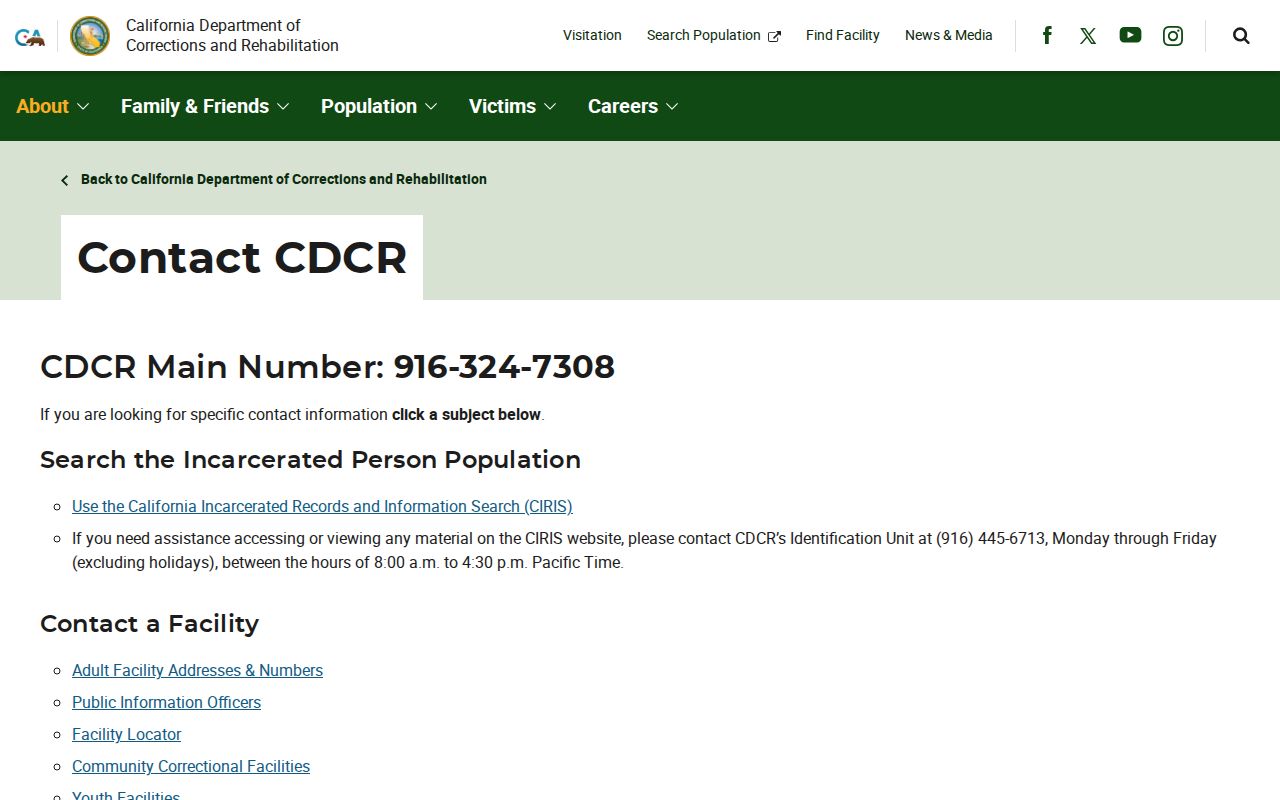
The CDCR contact and Identification Unit page supplies that fallback.
For a completed release, calculation record, or discharge record, use CDCR's Public Records Portal with a focused request. Include the full name, aliases, date of birth, CDCR number, institution, date range, and the precise record sought. That route is more reliable than asking for an undefined inmate file.
California Credits Change Release Dates
California does not have one simple good-time percentage for every person. Penal Code section 2933 says determinate terms should be served in full except for authorized reductions. It provides eligible prisoners up to six months of reduction for six continuous months, with proportional treatment for shorter periods, and describes credit as earnable and forfeitable rather than a right. Eligibility turns on more than that baseline.
Violent-felony cases have another limit. Penal Code section 2933.1 caps worktime credit at 15 percent for a person convicted of a violent felony listed in section 667.5(c). Section 2933.05 provides program-performance credits for approved rehabilitative programming, subject to its exclusions and limits. Proposition 57 also authorizes CDCR credits for good behavior and approved rehabilitative or educational achievements, while providing parole consideration after the full term for the primary nonviolent offense.
| Credit rule | Effect on the calculation | Key limit |
|---|---|---|
| Conduct or worktime credit | May reduce an eligible determinate term as credit is earned. | Can be denied, forfeited, or later restored. |
| Violent-felony worktime cap | Limits the amount of worktime credit used in covered cases. | Section 2933.1 applies to listed violent felonies. |
| Program-performance credit | May add an authorized reduction for approved programming. | Statutory exclusions and program rules apply. |
| Proposition 57 credit | Allows CDCR credit rules tied to conduct and approved achievements. | Sentence type, offense, date, and current regulations matter. |
CDCR's good-conduct-credit information describes percentages connected to 2021 emergency-rule changes, with different treatment for violent, nonviolent, fire-camp, and minimum-custody placements. Those dated categories cannot support a universal public calculator. Judicial credits, the offense date, sentence structure, later regulations, discipline, and statutory exclusions can all matter. Only the individual calculation can show how the rules combine.
What Moves California Release Dates
A release date can move in either direction. More eligible credit can advance an EPRD. Lost or denied credit can push it back, while restored credit may bring it forward again. A new court order can change the term or credits. A detainer, meaning another agency's request to hold or take custody of the person, may prevent release into the community even when one sentence reaches its calculated end.
| Event | Possible effect | Where to verify |
|---|---|---|
| Credit earned or restored | May move EPRD earlier when legally available. | CDCR case-records calculation and section 2932 notice. |
| Credit denied or forfeited | May move EPRD later after the required process. | CDCR notice and disciplinary or calculation record. |
| Court order or resentencing | May alter the term, custody credits, or legal basis for confinement. | Filing superior court and updated commitment record. |
| Parole decision | Can open or delay a release path but is not the act of release. | Board of Parole Hearings result and later review record. |
| Detainer or hold | May result in transfer or continued custody under another authority. | CDCR, the issuing agency, and relevant court. |
| Administrative processing | Can separate an authorized date from the completed physical exit. | Holding institution and release staff. |
For an indeterminate sentence, a Board of Parole Hearings grant is only a recommendation for release to parole and remains subject to legal and gubernatorial review. An upcoming hearing date also proves nothing about release. The official BPH hearing schedule identifies proceedings, not exit dates.
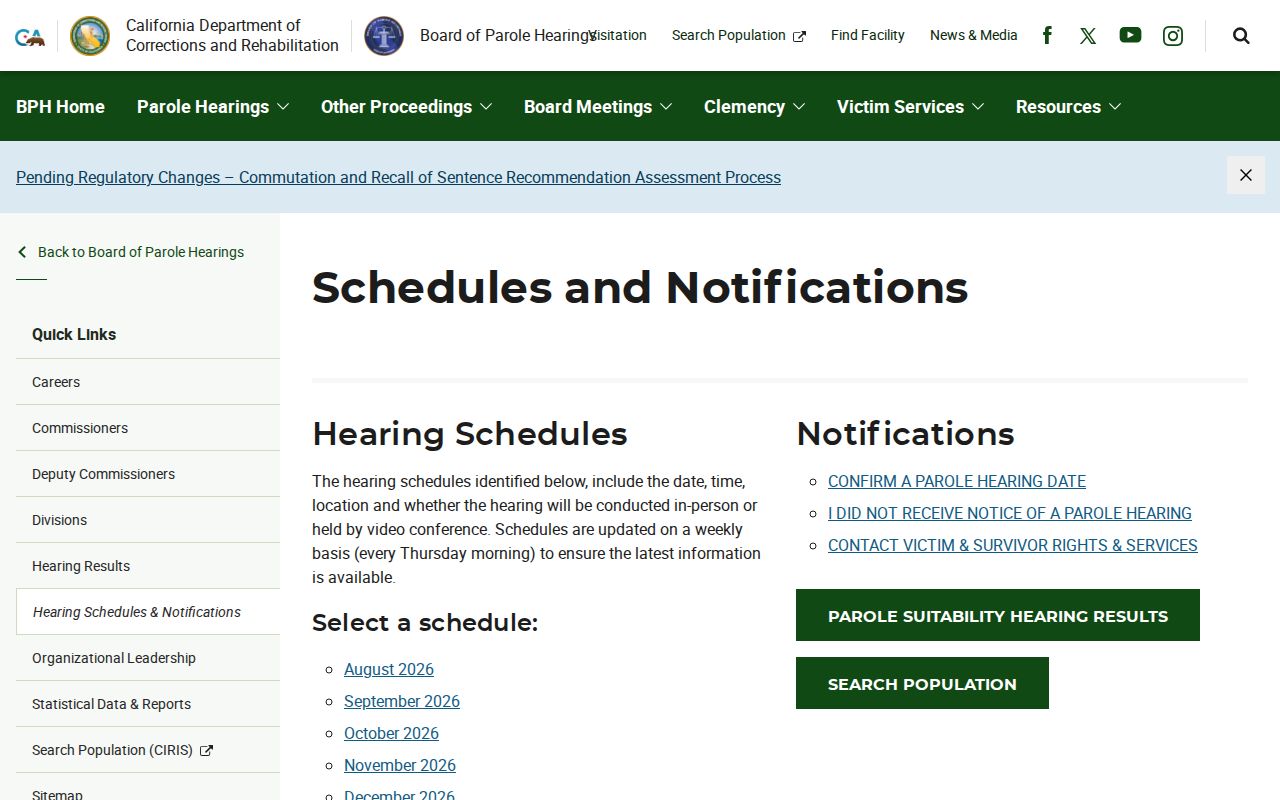
The schedule can help trace a pending decision. The outcome archive and later review must then be read in sequence. Never turn “Grant” into “Released” without proof that release processing was completed.
Note: A date ending one custody basis can mark transfer to another agency, not a return to the community.
California County Jail Release Dates
County jail dates follow a different path. A person awaiting trial does not have a CDCR sentence calculation. Bail action, an own-recognizance order, a dismissal, a plea, sentencing, a hold, or court remand may control the next event. For a sentenced county inmate, the sheriff or county corrections records unit can identify the local custody calculation, while the superior court record supplies the sentence and later orders.
California has 58 superior courts and no single statewide public trial-court name and disposition search. Start with the county where the case was filed. Remote criminal access can be limited to indexes, calendars, and registers of action, while fuller electronic records may require courthouse access. If a jail roster drops the person's name, that absence could reflect release, transfer, court movement, hospital movement, a hold, or data suppression.
- Pretrial
- Custody before final judgment, often without a sentence-based release date.
- Time served
- A disposition crediting enough prior custody to satisfy the ordered confinement.
- Detainer
- A request or authority that can keep the person held or cause transfer after another term ends.
- Remand
- A court order returning or committing the person to custody.
- Discharge
- The end of a custody or supervision authority, not merely leaving a building.
A focused California Public Records Act request may help after a name disappears from a live jail roster. Government Code section 7923.610 specifically lists the time and manner of release, or the current holding location, among arrest information subject to disclosure unless the safety or investigation exception applies. Ask the sheriff or local records unit for that exact fact and identify the person, booking, and date range.
Confirm a California Release Date
Confirmation requires the source that owns the custody. For CDCR, compare the current CIRIS result with the person's latest time-credit notice, Identification Unit response, or case-records calculation. For a county jail, contact the jail records unit and filing superior court. If parole follows, DAPO handles the state parole layer. If Postrelease Community Supervision follows, the county probation department named on the official release notice is responsible, and Penal Code section 3457 places that person outside CDCR jurisdiction for PRCS.
Notification can supplement the record but should not replace it. A VINE alert may report a county release or transfer, while qualifying state-prison registrants use CDCR's separate notification process after transfer. The California VINE inmate check explains that division and the limits of a no-result.
Federal dates must stay in the federal system. The BOP locator displays a projected release date for a current federal prisoner and warns that First Step Act credit recalculations can change it. A BOP “Released” or “Not in BOP Custody” result resolves only BOP custody. It does not prove that state, county, immigration, or supervision obligations ended.
Immigration detention has another boundary. ICE's Online Detainee Locator seeks adults currently held by ICE or in CBP custody beyond the period stated by the agency. It is not a past-release or removal archive. When a California jail or prison date arrives but an immigration hold exists, confirm the next custodian instead of treating the state or county date as release into the community. Exact name spelling, country of birth, date of birth, and a properly formatted A-number matter in that separate search.
Keep a short verification record: the person's stable ID, the exact field label, its value, the source agency, and the date checked. Recheck close to the expected event. Most errors arise when a parole milestone is called a release date, a projection is called final, or absence from one locator is treated as proof across every system.